My life story starting with my childhood years in the small town of Barotac Viejo, Iloilo, Philippines up to my retirement from the United States Food and Drug Administration, Center of New Drugs in 2002 and beyond. Some of the photos and videos in this site, I do not own. However, I have no intention in infringing on your copyrights.
Yesterday, I received the following four e-mails as a retired member of the Philippine Academy of Science and Engineering (PAASE). I was surprise to read that not all of Our PAASE members were aware of the writings of Mr. Bulosan. The e-mails
reminded me of my article on my blogs on Carlos Bulosan posted on July 22, 2013 below.
Here are the five E-mails from members of PAASE :
Assembly Member Rob Bonta Celebrates $1M Bulosan Center for Filipino Studies
1. DAVIS,
CA — On the occasion of Filipino American History Month,
Assembly member Rob Bonta celebrates the recent $1M allocation from the
state--an effort he led with support from the Filipino American
community--to the Bulosan Center for Filipino Studies. The Bulosan
Center was first established in 2018 exclusively through donor funds. A press conference will take place on Thursday, October 24th, 2019 at NOON in 3201 Hart Hall at the UC Davis campus.
The
Bulosan Center for Filipino Studies is the first and only center in the
University of California system and nationally devoted to promoting
research on the Filipino American and diasporic community. Its mission
is to uplift the voices of the most marginalized in the Filipino
community in the United States and the diaspora through
community-engaged research and by broadly disseminating knowledge about
Filipinos to advance their rights and welfare.
Sample highlights from 2018-19:
●
preserved Filipino American history—initially with a focus on
Filipino Americans’ leadership and contribution to the United Farm
Workers (often attributed exclusively to Cesar Chavez and Dolores
Huerta) through the publicly accessible Welga digital archive and
developed curriculum with K-12 based on the archive’s sources;
●
disseminated the Filipino American historical experience to hundreds
of Filipino American youth and community members through public
exhibitions, workshops and lectures.
Some initiatives for 2019-20:
*
National
Survey, “Filipinos Count: A National Survey on the Health and
Well-Being of Filipino Americans,” this survey is the first of its kind
since the late 1990s;
*
Lab for New
Media Justice, to encourage experimentation with digital and other forms
of media to further document the stories of everyday Filipino Americans
as they struggle against racism, heterosexism, exploitation and other
forms of marginalization, but to also “translate” Filipino American
scholarship for broader consumption.
2. California's allocation of $1M to the Bulosan Center
for Filipino Studies at UC Davis is terrific and most welcome news. As
for Carlos Bulosan, I regret that I am not familiar yet with his work,
but will make an effort.
3. I
wanted to share the announcement below with you. Cesar Chavez and the
United Farm Workers put civil rights of Latinx people firmly in
California history. What many people don’t realize is that many of the
early founders were Filipino farm workers. There is a growing awareness
of Filipino contributions in California and the US. Prof. Robyn
Rodriguez is a professor in Davis and started the first National program
on Filipino Americans. There is now a Filipino Ethnic Study program in
UC Davis.
4. I am an offspring of the early field
hands from Ilocos Norte who worked in the fields of Hawaii and
California. While in high school my summer job was working in the
lettuce and celery fields of Salinas and King City with my uncle who
lived in Salinas. Lived in the ‘campo’ with ‘braceros’ and ‘manongs’, my
uncle was a foreman for one of the farms, witness to a bit of their
lifestyle. That view into the hard life of the ‘manongs’ was motivation
enough to study hard and do physics. Great to know about the support for Bulosan Center.
*******************************************************************************
5. We appreciated your sharing a bit of your family history with us and its roots that extended from the fields of Ilocos Norte to those of Hawaii and California. Family histories such as yours in union with those of thousands of other Filipino -Americans and Filipinos in diaspora in the United States are absolutely and crucially foundational to the identities of Filipino-Americans both today and in future in that they help locate and even localize in America the deep-rooted genesis of the Filipino-American experience -- one that is in no way inequivalent and unequal to the experiences of the Anglo-Saxons and other immigrants who came here to the U.S. I fully salute the Filipino Ethnic Studies program at the Bulosan Center for Filipino Studies at UC Davis.
6. My article posted on July 22, 2013(https://davidbkatague.blogspot.com/search?q=carlos+bulosan)
The
prejudice against Filipino immigrants in the US and specially in
California in the 1920s to 1940s is well documented. One of the
well-known books, America is in the Heart, documenting the life
of the Filipino immigrants at that time period, was written by Carlos
Bulosan. Mr Bulosan is my number one literary heroes of that time.
Like
many Filipinos during that time, Bulosan left for America in July 1930
at age 17, in the hope of finding salvation from the economic depression
of his home. He never again saw his Philippine homeland. No sooner had
he arrived in Seattle, was he immediately met with the hostility of
racism, forcing him to work in low paying jobs.
He
worked as a farm worker, harvesting grapes, asparagus and other kinds
of hard labor work in the fields of California. He also worked as a
dishwasher with his brother, Lorenzo in the famous Madonna Inn in San
Luis Obispo. He was active in labor politics along the Pacific coast of
the United States and edited the 1952 Yearbook for ILWU Local 37, a
predominantly Filipino American cannery union based in Seattle.
Mr
Bulosan died in 1956. To honor his memory, a Bulusan Memorial Exhibit
located in Seattle's International District and in the Eastern Hotel
features his literary works and manuscripts. One of his famous books,
America is in the Heart based on his autobiography is now made into a
Philippine movie, Hanggang Sa Muli.( Until Then)_ Till we Met
Again),(Hasta La Vista).
One
of the famous quotes from that book is timeless, as follows: "We in
America understand the many imperfections of democracy and the malignant
disease corroding its very heart. We must be united in the effort to
make an America in which our people can find happiness. It is a great
wrong that anyone in America, whether he be brown or white, should be
illiterate or hungry or miserable."
Here are two videos of the highlights of Carlos Bulosan biography:
The prejudice against Filipino immigrants in the US and specially in California in the 1920s to 1940s is well documented (1,2). One of the well-known books, America is in the Heart, documenting the life of the Filipino immigrants at that time period, was written by Carlos Bulosan. Mr Bulosan is my number one literary heroes of that time.
Like many Filipinos during that time, Bulosan left for America in July 1930 at age 17, in the hope of finding salvation from the economic depression of his home. He never again saw his Philippine homeland. No sooner had he arrived in Seattle, was he immediately met with the hostility of racism, forcing him to work in low paying jobs.
He worked as a farm worker, harvesting grapes, asparagus and other kinds of hard labor work in the fields of California. He also worked as a dishwasher with his brother, Lorenzo in the famous Madonna Inn in San Luis Obispo. He was active in labor politics along the Pacific coast of the United States and edited the 1952 Yearbook for ILWU Local 37, a predominantly Filipino American cannery union based in Seattle.
Mr Bulosan died in 1956. To honor his memory, a Bulusan Memorial Exhibit located in Seattle's International District and in the Eastern Hotel features his literary works and manuscripts. One of his famous books, America is in the Heart based on his autobiography is now made into a Philippine movie, Hanggang Sa Muli.( Until Then)_ Till we Met Again),(Hasta La Vista).
One of the famous quotes from that book is timeless, as follows: "We in America understand the many imperfections of democracy and the malignant disease corroding its very heart. We must be united in the effort to make an America in which our people can find happiness. It is a great wrong that anyone in America, whether he be brown or white, should be illiterate or hungry or miserable."
Discrimination against Filipinos was very blatant during the time of the Manongs and Carlos Bulosan. It appeared that by the 1960s, racial discrimination had disappeared from the minds of the American people. But in 1965, my wife and three children experienced their first discrimination experience in Gladstone, Missouri.
Gladstone is a northern suburb of Kansas City, Missouri with about 99.5% Caucasian population at that time.
The discrimination was not blatant but very subtle. After relocating in Missouri for my first job after my Ph.D. graduation from the University of Illinois, my family and I joined a Country Swim Club just a couple of blocks and a walking distance from our rented residence.
My wife, Macrine, and the kids would swim at the country club twice or three times a week. The first day, they were there, she overheard the conversation from two middle-aged ladies. She heard a comment of the first lady to her friend, "Look we are getting invaded by blacks already". Macrine looked around, but there were no black families around; she and the kids were the only colored (brown) people relaxing and swimming in the pool area. Macrine was bothered by what she heard but did not get upset. She continued watching the kids swimming in the pool.
Suffice to say, I had never experienced an incident of prejudice or a discriminatory remark in my more than 53 years residing and working here in the US (California, Illinois, Missouri and Maryland).
After our second year in the neighborhood, we became more active socially and became well-known to the Gladstone community. I was elected by the members of the club as treasurer for two years. I was handling the payroll of three employees and collecting the membership fees of the 300 members. I was delighted that the club members and Board of Directors trusted me with their finances. I therefore conclude that the cure for discrimination is education and ignorance is the mother of prejudice.
If you are a Filipino-American or a member of a minority and are reading this article, have you ever experienced prejudice or discrimination in your life here in the US? Discrimination may be racial, religious, sexual, financial or your educational status.
(1) Carlos Bulosan, America Is in the Heart, 1946 (2) The Delano Manongs:Forgotten Heroes of the United Farm Workers-a Video by mediafactory.tv/2008/01
I was looking at my files the other day on my most popular or widely read blogs in 2011. The following posting has over 900 page views and I am reposting it today as follows:
Prejudice and Discrimination Against Filipinos
The prejudice against Filipino immigrants in the US and specially in California in the 1920s to 1940s is well documented💚 (1, 2). One of the well known books discussing Discrimination Against Filipinos was America is in the Heart. It documented the life of the Filipino immigrants at that time period. It was written by Carlos Bulosan. Mr Bulosan is my number one literary heroes of that time.
Like many Filipinos during that time, Bulosan left for America on July, 1930 at age 17, in the hope of finding salvation from the economic depression of his home. He never again saw his Philippine homeland. No sooner had he arrived in Seattle, was he immediately met with the hostility of racism, forcing him to work in low paying jobs.
He worked as a farm worker, harvesting grapes, asparagus and other kinds of hard labor work in the fields of California. He also worked as a dishwasher with his brother, Lorenzo in the famous Madonna Inn in San Luis Obispo. He was active in labor politics along the Pacific coast of the United States and edited the 1952 Yearbook for ILWU Local 37, a predominantly Filipino American cannery union based in Seattle.
Mr Bulosan died in 1956. To honor his memory, a Bulusan Memorial Exhibit located in Seattle's International District and in the Eastern Hotel features his literary works and manuscripts. One of his famous books, America is in the Heart based on his autobiography is now made into a Philippine movie.
One of the famous quote from that book is timeless, as follows: "We in America understand the many imperfections of democracy and the malignant disease corroding its very heart. We must be united in the effort to make an America in which our people can find happiness. It is a great wrong that anyone in America, whether he be brown or white, should be illiterate or hungry or miserable."
Discrimination against the Filipinos was very blatant during the time of the Manongs and Carlos Bulosan. It appeared that by the 1960's, racial discrimination has disappeared from the minds of the American people.
But in 1965, my wife and three children experienced their first discrimination experience in Gladstone, Missouri. Gladstone is a northern suburb of Kansas City, Missouri with about 99.5% Caucasian population at that time.
The discrimination was not blatant but very subtle. After relocating in Missouri for my first job after my Ph.D graduation from the University of Illinois, my family and I joined a Country Swim Club just a couple of blocks and a walking distance from our rented residence.
Macrine and the kids would swim at the country club twice or three times a week. The first day, they were there, she overheard the conversation from two middle-aged ladies. She heard a comment of the first lady to her friend, "look we are getting invaded by blacks already". Macrine look around, but there were no black families around; she and the kids were the only colored ( brown) relaxing and swimming in the pool area.
Macrine was not bothered and did not get upset. She continued watching the kids swimming in the pool. Suffice to say, I had never experienced personally, an incident of prejudice or a discriminatory remark in my more than 51 years residing and working here in the US(California, Illinois, Missouri and Maryland).
After our second year in the neighborhood, we became more active socially and became well-known to the Gladstone community. I was elected by the members of the club as treasurer for two years. I was handling the payroll of three employees and collecting the membership fees of the 300 members. I was delighted that the club members and Board of Directors trusted me with their finances. I therefore conclude that the cure for discrimination is education and ignorance is the mother of prejudice.
If you are a Filipino-American or a member of a minority and is reading this article, have you ever experienced prejudice or discrimination in your life here in the US? Discrimination may be racial, religious, sexual, financial or your educational status.
Note: I would like to hear from you, if you experienced discrimination blatant or subtle.
💚(1) Carlos Bulosan, America Is in the Heart, 1946 (2) The Delano Manongs: Forgotten Heroes of the United Farm Workers-a Video by mediafactory.tv/2008/01
Christian Family Movement Logo (CFM)
In 1959-1960 I went to the US to accept a teaching assistantship and tuition scholarship at the University of Illinois in Chicago, after teaching chemistry at the University of the Philippines for four years. I went ahead and left my wife and oldest son in the Philippines. That first year was the loneliest time of my life. Not only did I had to adjust to the cold winters of Chicago, but also did missed my family especially on Holidays and during the Christmas season.
Fortunately, I had some "ugly Americans" classmates. Ten of them, gave me the best Christmas present in my life at that time. My ten classmates contributed enough money to pay for a long distance international call from Chicago to the Philippines. They pre-arranged the call so that it would coincide during our Christmas party. One of my classmates, Dr. Lee Gardella of Chicago was the mastermind of this surprise. He requested his mother who at that time was working for the local telephone company, to arrange this call without me knowing it. They wanted to surprise me. Boy, was I surprise when at the middle of the party, they called me, I had a telephone call. Tears flowed in my eyes and my heart pumped with joy as I heard my wife's voice from the Philippines. As a graduate student I was very poor. I did not have enough money to call my wife. Although my tuition is free, my stipend of $190 a month was barely enough to support me. I was paying already $89 for my apartment and the rest for food and incidentals. I wrote an essay about this surprise gift while I was working for Stauffer Chemicals in Richmond, California . The essay won a $75 award as one of the top ten Christmas story from its employees. I titled the essay A Christmas Story- The Ugly Americans".
The book (bestseller in 1960) that inspired me to write, Christmas Story
In 1964, I graduated with a Ph.D. degree in Pharmaceutical Chemistry. My first job was with Chemagro Corporation located in Kansas City, Missouri. My wife and I at that time had already three children, two of them courtesy of U. Illinois hospital. My oldest son, was born in the Philippines. Our youngest daughter was born in 1965 in North Kansas City Hospital,a year later.
I had another true story on the birth of our son- third child in 1962. In order to save money, I moved the family from the University apartments to a student housing subsidized by the state. The housing was about five miles from the university.
One night while Macrine was preparing thanksgiving dinner, she started labor pains. I was so excited,I did not realized I was driving about 70 miles in a 40 miles speed zone. So there goes the police car with the blinking lights and loudspeaker. I stopped by the side of the road, blurted to the police " I am going to have a baby". The policeman looked at me and answered back," No you are not! your wife is ! Come follow me to the hospital". So we have a police car with his blinking lights and siren escorting us to the emergency room of the University Of Illinois Hospital.
Our community involvement were with the Catholic Church, the local country club and with the CFM ( Christian Family Movement) in the Kansas City Diocese.
OR FILIPINOS EITHER
Our life in the midwest will not be complete, If I do not discuss, the prejudice and discrimination encountered by the Filipino immigrants im the 1920s to 1940s. The following article, I had submitted and published in ViewsHound also included a discriminatory remark that Macrine heard from two women who were members of our country swim club near our residence in Gladstone, Misouri-a northern suburb of Kansas City, Missouri.
The prejudice against Filipino immigrants in the US and specially in California in the 1920s to 1940s is well documented(1,2). One of the well known books on this subject,"America is in the Heart", written by Carlos Bulosan documented the life of the Filipino immigrants at that time period. Mr Bulosan is my number one literary heroes of that time.
Like many Filipinos during that time, Bulosan left for America on July, 1930 at age 17, in the hope of finding salvation from the economic depression of his home. He never again saw his Philippine homeland. No sooner had he arrived in Seattle, was he immediately met with the hostility of racism, forcing him to work in low paying jobs.
He worked as a farm worker, harvesting grapes, asparagus and other kinds of hard labor work in the fields of California. He also worked as a dishwasher with his brother, Lorenzo in the famous Madonna Inn in San Luis Obispo. He was active in labor politics along the Pacific coast of the United States and edited the 1952 Yearbook for ILWU Local 37, a predominantly Filipino American cannery union based in Seattle.
Mr Bulosan died in 1956. To honor his memory, a Bulusan Memorial Exhibit located in Seattle's International District and in the Eastern Hotel features his literary works and manuscripts. One of his famous books, America is in the Heart based on his autobiography is now made into a Philippine movie.
One of the famous quote from that book is timeless, as follows: "We in America understand the many imperfections of democracy and the malignant disease corroding its very heart. We must be united in the effort to make an America in which our people can find happiness. It is a great wrong that anyone in America, whether he be brown or white, should be illiterate or hungry or miserable."
Discrimination against the Filipinos was very blatant during the time of the Manongs and Carlos Bulosan. It appeared that by the 1960's, racial discrimination has disappeared from the minds of the American people. But in 1965, my wife and three children experienced their first discrimination experience in Gladstone, Missouri.
Gladstone is a northern suburb of Kansas City, Missouri with about 99.5% Caucasian population at that time.
The discrimination was not blatant but very subtle. After relocating in Missouri for my first job after my Ph.D graduation from the University of Illinois, my family and I joined a Country Swim Club just a couple of blocks and a walking distance from our rented residence.
My wife, Macrine, and the kids would swim at the country club twice or three times a week. The first day, they were there, she overheard the conversation from two middle-aged ladies. She heard a comment of the first lady to her friend, "look we are getting invaded by blacks already". Macrine look around, but there were no black families around; she and the kids were the only colored ( brown) relaxing and swimming in the pool area. Macrine was bothered by what she heard but did not get upset. She continued watching the kids swimming in the pool. Suffice to say, I had never experienced personally, an incident of prejudice or a discriminatory remark in my more than 51 years residing and working here in the US(California, Illinois, Missouri and Maryland).
After our second year in the neighborhood, we became more active socially and became well-known to the Gladstone community. I was elected by the members of the club as treasurer for two years. I was handling the payroll of three employees and collecting the membership fees of the 300 members. I was delighted that the club members and Board of Directors trusted me with their finances. I therefore conclude that the cure for discrimination is education and ignorance is the mother of prejudice.
If you are a Filipino-American or a member of a minority and is reading this article, have you ever experienced prejudice or discrimination in your life here in the US? Discrimination may be racial, religious, sexual, financial or your educational status.
(1) Carlos Bulosan, America Is in the Heart, 1946
Macrine and I organized the first ecumenical CFM group in the Kansas City Diocese. CFM was founded by Pat and Patty Crowley of Wheaton, Illinois. While we were in Chicago, we were very fortunate to be invited to their home along with other foreign students studying in the Chicago area. These social events were welcome by us, because we meet other students from other parts of the world; we have a lot things in common to talk about. Thus, after graduation, we made it a point to get involve with the local CFM group. We wrote the Crowley's of our impressions of America as students. It was published in the ACT MAGAZINE dated May, 1968 as follows: Simple Gifts is the book that chronicles the lives of Pat and Patty Crowley. They had a big influence in our lives while I was a graduate student at the University of Illinois.
" Not long ago we received an interesting letter from Dave and Macrine Katague. In the early part of this decade they spent four years as graduate students at the University of Illinois in Chicago. As native of the Philippines, they were in a strange city and a strange land. They would not have learned very much about it, had it not been for the hospitality extended by CFM groups as well as Executive Secretary Couple Pat and Patty Crowley. Reflecting upon their past experiences, Dave and Macrine Katague wonder about the attitudes of those who spent times in the States, but did not learn to know the people of our country." They write:
Our Impression of America
" During our first year in Chicago, we never received an invitation to participate in the hospitality program. Our name was probably buried in the list of foreign students or perhaps our foreign student adviser was sleeping in her job. During these first year of adjustments to the American way of life, we formed a very wrong impression of Americans. Asides from our daily contacts with fellow students in the school rooms or dormitories, our only other social contacts were people in the streets, subways, buses, department stores, supermarkets and other public places. These were all artificial contacts, giving us an impression that Americans are unfriendly, artificial, insincere, apathetic,intolerant and above all ignorant.The latter adjective was quite true, since the ordinary or typical American does not have the vaguest idea where the Philippines, Japan or even Puerto Rico is located in the map.
" However, in our second year, we began receiving invitation to spend a weekend in suburban homes as well as dinner nvitations in city homes. At first, we were reluctant to accept the invitation, however with our adventurous spirit, we said yes.
From then on, "we have the whole world in our hands". We are thankful to CFM, the YWCA and the Hospitality Center of Chicago for making our stay filled with pleasant memories.
"On the other hand what impressions could we have brought back to the Philippines, if our stay was limited to one or two years ( true for exchange visitors). How many visitors and exchange scholars brought home with them the wrong impressions and attitude towards the American people in general? I knew there were a few foreign students in the dormitories who were disillusioned about the United States. One of them was a former dorm mate from Chile. He received an invitation, but never did conquer his apprehension of accepting one.
" At present as couple leader of the first interfaith group in our diocese, we will do our very best to reciprocate, promote, and encourage hospitality programs to foreign students and scholars in our area. We believe that opening our homes and our hearts on weekends and holidays, is one of the best ways of promoting world peace and understanding. Let us then make it possible for foreign students and scholars get the true picture of America and its people. Let us give them the opportunity to share with us our way of life. Let us get busy as a group or perhaps join other groups in order that we can show to the future leaders of the world, how sincere, friendly and aware we are of other human beings in other parts of the world. This is one of the many ways we could be more Christlike, we believe".
This letter was published by CFM in their monthly magazine, ACT, for all their members worldwide.
I first wrote my autobiography in 2008 and updated it in 2011. There are several things that changed since 2011 in my family personal lives and a few significant events that is needed to be updated. I will include more photos so the articles will be not too boring for those who have already read this post. Again, I will appreciate any comments positive or negative. I will highlights all the updates. Christian Family Movement Logo (CFM)
In 1959-1960 I went to the US to accept a teaching assistantship and tuition scholarship at the University of Illinois in Chicago, after teaching chemistry at the University of the Philippines for three years. I went ahead and left my wife and oldest son in the Philippines. That year was the loneliest time of my life. Not only did I had to adjust to the cold winters of Chicago, but also did missed my family especially on Holidays and during the Christmas season. First Winter Season in the US.
Fortunately, I had some "ugly Americans" classmates. Six of them, gave me the best Christmas present in my life at that time. My six classmates contributed enough money to pay for a long distance international call from Chicago to the Philippines. They pre-arranged the call so that it would coincide during our Christmas party. One of my classmates, Dr. Lee Gardella of Chicago was the mastermind of this surprise. He requested his mother who at that time was working for the local telephone company, to arrange this call without me knowing it. They wanted to surprise me. Boy, was I surprise when at the middle of the party, they called me, I had a telephone call. Tears flowed in my eyes and my heart pumped with joy as I heard my wife's voice from the Philippines. As a graduate student I was very poor. I did not have enough money to call my wife. Although my tuition is free, my stipend of $190 a month was barely enough to support me. I was paying already $89 for my apartment and the rest for food and incidentals. I wrote an essay about this surprise gift while I was working for Stauffer Chemicals in Richmond, California . The essay won a $75 award as one of the top ten Christmas story from its employees. I titled the essay A Christmas Story- The Ugly Americans".
The book (bestseller in 1960) that inspired me to write, Christmas Story
In 1964, I graduated with a Ph.D. degree in Pharmaceutical Chemistry. My first job was with Chemagro Corporation located in Kansas City, Missouri. My wife and I at that time had already three children, two of them courtesy of U. Illinois hospital. My oldest son, was born in the Philippines. Our youngest daughter was born in 1965 in North Kansas City Hospital,a year later.
I had another true story on the birth of our son- third child in 1962. In order to save money, I moved the family from the University apartments to a student housing subsidized by the state. The housing was about five miles from the university.
One night while Macrine was preparing thanksgiving dinner, she started labor pains. I was so excited,I did not realized I was driving about 70 miles in a 40 miles speed zone. So there goes the police car with the blinking lights and loudspeaker. I stopped by the side of the road, blurted to the police " I am going to have a baby". The policeman looked at me and answered back," No you are not! your wife is ! Come follow me to the hospital". So we have a police car with his blinking lights and siren escorting us to the emergency room of the University Of Illinois Hospital.
Our community involvement were with the Catholic Church, the local country club and with the CFM ( Christian Family Movement) in the Kansas City Diocese.
OR FILIPINOS EITHER
Our life in the Midwest will not be complete, If I do not discuss, the prejudice and discrimination encountered by the Filipino immigrants in the 1920s to 1940s. The following article, I had submitted and published in ViewsHound also included a discriminatory remark that Macrine heard from two women who were members of our country swim club near our residence in Gladstone, Missouri-a northern suburb of Kansas City, Missouri.
The prejudice against Filipino immigrants in the US and specially in California in the 1920s to 1940s is well documented(1,2). One of the well known books on this subject,"America is in the Heart", written by Carlos Bulosan documented the life of the Filipino immigrants at that time period. Mr Bulosan is my number one literary heroes of that time.
Like many Filipinos during that time, Bulosan left for America on July, 1930 at age 17, in the hope of finding salvation from the economic depression of his home. He never again saw his Philippine homeland. No sooner had he arrived in Seattle, was he immediately met with the hostility of racism, forcing him to work in low paying jobs.
He worked as a farm worker, harvesting grapes, asparagus and other kinds of hard labor work in the fields of California. He also worked as a dishwasher with his brother, Lorenzo in the famous Madonna Inn in San Luis Obispo. He was active in labor politics along the Pacific coast of the United States and edited the 1952 Yearbook for ILWU Local 37, a predominantly Filipino American cannery union based in Seattle.
Mr Bulosan died in 1956. To honor his memory, a Bulusan Memorial Exhibit located in Seattle's International District and in the Eastern Hotel features his literary works and manuscripts. One of his famous books, America is in the Heart based on his autobiography is now made into a Philippine movie.
One of the famous quote from that book is timeless, as follows: "We in America understand the many imperfections of democracy and the malignant disease corroding its very heart. We must be united in the effort to make an America in which our people can find happiness. It is a great wrong that anyone in America, whether he be brown or white, should be illiterate or hungry or miserable."
Discrimination against the Filipinos was very blatant during the time of the Manongs and Carlos Bulosan. It appeared that by the 1960's, racial discrimination has disappeared from the minds of the American people. But in 1965, my wife and three children experienced their first discrimination experience in Gladstone, Missouri.
Gladstone is a northern suburb of Kansas City, Missouri with about 99.5% Caucasian population at that time.
The discrimination was not blatant but very subtle. After relocating in Missouri for my first job after my Ph.D graduation from the University of Illinois, my family and I joined a Country Swim Club just a couple of blocks and a walking distance from our rented residence.
My wife, Macrine, and the kids would swim at the country club twice or three times a week. The first day, they were there, she overheard the conversation from two middle-aged ladies. She heard a comment of the first lady to her friend, "look we are getting invaded by blacks already". Macrine look around, but there were no black families around; she and the kids were the only colored ( brown) relaxing and swimming in the pool area. Macrine was bothered by what she heard but did not get upset. She continued watching the kids swimming in the pool. Suffice to say, I had never experienced personally, an incident of prejudice or a discriminatory remark in my more than 51 years residing and working here in the US(California, Illinois, Missouri and Maryland).
After our second year in the neighborhood, we became more active socially and became well-known to the Gladstone community. I was elected by the members of the club as treasurer for two years. I was handling the payroll of three employees and collecting the membership fees of the 300 members. I was delighted that the club members and Board of Directors trusted me with their finances. I therefore conclude that the cure for discrimination is education and ignorance is the mother of prejudice.
If you are a Filipino-American or a member of a minority and is reading this article, have you ever experienced prejudice or discrimination in your life here in the US? Discrimination may be racial, religious, sexual, financial or your educational status.
(1) Carlos Bulosan, America Is in the Heart, 1946
Macrine and I organized the first ecumenical CFM group in the Kansas City Diocese. CFM was founded by Pat and Patty Crowley of Wheaton, Illinois. While we were in Chicago, we were very fortunate to be invited to their home along with other foreign students studying in the Chicago area. These social events were welcome by us, because we meet other students from other parts of the world; we have a lot things in common to talk about. Thus, after graduation, we made it a point to get involve with the local CFM group. We wrote the Crowley's of our impressions of America as students. It was published in the ACT MAGAZINE dated May, 1968 as follows: Simple Gifts is the book that chronicles the lives of Pat and Patty Crowley. They had a big influence in our lives while I was a graduate student at the University of Illinois.
" Not long ago we received an interesting letter from Dave and Macrine Katague. In the early part of this decade they spent four years as graduate students at the University of Illinois in Chicago. As native of the Philippines, they were in a strange city and a strange land. They would not have learned very much about it, had it not been for the hospitality extended by CFM groups as well as Executive Secretary Couple Pat and Patty Crowley. Reflecting upon their past experiences, Dave and Macrine Katague wonder about the attitudes of those who spent times in the States, but did not learn to know the people of our country." They write:
Our Impression of America
" During our first year in Chicago, we never received an invitation to participate in the hospitality program. Our name was probably buried in the list of foreign students or perhaps our foreign student adviser was sleeping in her job. During these first year of adjustments to the American way of life, we formed a very wrong impression of Americans. Asides from our daily contacts with fellow students in the school rooms or dormitories, our only other social contacts were people in the streets, subways, buses, department stores, supermarkets and other public places. These were all artificial contacts, giving us an impression that Americans are unfriendly, artificial, insincere, apathetic,intolerant and above all ignorant.The latter adjective was quite true, since the ordinary or typical American does not have the vaguest idea where the Philippines, Japan or even Puerto Rico is located in the map.
" However, in our second year, we began receiving invitation to spend a weekend in suburban homes as well as dinner invitations in city homes. At first, we were reluctant to accept the invitation, however with our adventurous spirit, we said yes.
From then on, "we have the whole world in our hands". We are thankful to CFM, the YWCA and the Hospitality Center of Chicago for making our stay filled with pleasant memories.
"On the other hand what impressions could we have brought back to the Philippines, if our stay was limited to one or two years ( true for exchange visitors). How many visitors and exchange scholars brought home with them the wrong impressions and attitude towards the American people in general? I knew there were a few foreign students in the dormitories who were disillusioned about the United States. One of them was a former dorm mate from Chile. He received an invitation, but never did conquer his apprehension of accepting one.
" At present as couple leader of the first interfaith group in our diocese, we will do our very best to reciprocate, promote, and encourage hospitality programs to foreign students and scholars in our area. We believe that opening our homes and our hearts on weekends and holidays, is one of the best ways of promoting world peace and understanding. Let us then make it possible for foreign students and scholars get the true picture of America and its people. Let us give them the opportunity to share with us our way of life. Let us get busy as a group or perhaps join other groups in order that we can show to the future leaders of the world, how sincere, friendly and aware we are of other human beings in other parts of the world. This is one of the many ways we could be more Christlike, we believe".
This letter was published by CFM in their monthly magazine, ACT, for all their members worldwide.
Ditas and Me and Former Governor Arnold S- Ditas former old Boss, 2006
This is my response to the query on my three most widely read articles from my Hubpages Writing Account for StoryWorth. As of this writing date here are the 3 articles with their Number of Page Views( Readers) and Comments: In this article, I will published only excerpts from #2. Excerpts from #1 and #3 will be in two separate articles.
1. My Bucket List -101 Things to Do before I Die, 9,701 page views and 10 comments.
2. Caste System and Discrimination in the Philippines -7,730 page views and 31 comments
3. Encounters with Aswangs, Nono's, and Ghost in the Philippines-5,207 page views and 20 comments
I had stopped writing new articles for Hubpages two years ago. As of today, I have 25 articles with a total page views of 31,584 and 182 readers' comments.
Here's an Excerpts from my most commented article -Caste System in the Philippines-Discrimination of Filipinos in the United States and my Pinoy Pride List
Caste System in the Philippines
There
is a caste system between the poor and the rich and the educated and
non educated Filipinos. The Overseas Filipino Workers( OFW's) are
considered the modern economic heroes of the Philippines. Their
remittances help uplift the economic woes of the country. Will the OFW's
be another caste group of the future in the Philippines?
In this hub/article, I have also listed 20 Filipino and Filipino-Americans in my Pride List.
Is there a Caste System in the Philippines?
The
Philippines is not India or Pakistan. But better believe it, there is a
caste system in the Philippines. The caste system exits between the
rich and the poor, between educated and uneducated, and to a lesser
extent between the Filipino-mestizos and the “browned-skinned and
flat-nosed” Filipinos.
Let me start with the clash between the
rich and the poor. It is well known that the Philippines is not really a
true democracy but an oligarchy. Oligarchy is defined by Webster as a
form of government in which the supreme power is in the hands of a small
exclusive class. This exclusive group are the rich. If you live in the
Philippines, you know or have heard of a few families that run our
country as well as our business. And what about the poor? They just
suffer and accept what is handed to them, good or bad!
The
second item is the clash between the educated and uneducated. The
educated usually had comfortable lives, excellent social status,
travels, eat in five-star restaurants and also send their children to
excellent schools. The uneducated have lower social status, do the
menial jobs and if lucky can get jobs as farming tenants, personal
maids, or drivers of the rich and educated Filipinos. In Marinduque,
there are hundreds of tenants who work for the rich landowners. These
folks were raised as Roman Catholics, but only go to Church twice a
year, during Christmas and Easter. When invited to your house in town,
they will not enter your front door. They enter the back door. Entering
the front door is bad manners. They will not eat at the same time with
you, even though you invite them. They will wait until you are finished
before they eat.
On the last item of heritage, Spanish mestizos
versus brown skinned Filipinos. Today, this is not so blatant. But
during my grandparents and parents time, the mestizos feel they are
superior in terms of social standing and race. My grandparents speak
fluent Spanish as well as local dialect (Tagalog or Ilonggo) and are the
elites of society. The mestizos would look down on the non-mestizos or
even the Chinese Filipinos. In Marinduque, a few decades ago, if you
were Filipino-Chinese, you would not be invited or included in the
social activities of the “socialites”, even though you are doing well as
a businessman. It is only today that it is no longer a social taboo to
invite the non-mestizos to your home for socializing. During my
grandparents' time, it was also a taboo to marry outside your social
class. Children of the rich are discouraged to associate with children
of families that reside on the “other side of the river” (similar to
American expression of the “other side of the railroad track”).
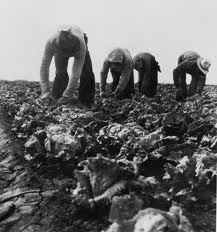
Discrimination of Filipinos in US in the 1930's
Filipinos Working in the Farms of Central California in the 1930's
Filipino Discrimination in the US in the 1930s and 1960s
The
prejudice against Filipino immigrants in the US and specially in
California in the 1920s to 1940s is well documented. One of the
well-known books, America is in the Heart, documenting the life of the
Filipino immigrants at that time period, was written by Carlos Bulosan.
Mr Bulosan is my number one literary heroes of that time.
Like
many Filipinos during that time, Bulosan left for America in July 1930
at age 17, in the hope of finding salvation from the economic depression
of his home. He never again saw his Philippine homeland. No sooner had
he arrived in Seattle, was he immediately met with the hostility of
racism, forcing him to work in low paying jobs.
He worked as a
farm worker, harvesting grapes, asparagus and other kinds of hard labor
work in the fields of California. He also worked as a dishwasher with
his brother, Lorenzo in the famous Madonna Inn in San Luis Obispo. He
was active in labor politics along the Pacific coast of the United
States and edited the 1952 Yearbook for ILWU Local 37, a predominantly
Filipino American cannery union based in Seattle.
Mr
Bulosan died in 1956. To honor his memory, a Bulusan Memorial Exhibit
located in Seattle's International District and in the Eastern Hotel
features his literary works and manuscripts. One of his famous books,
America is in the Heart based on his autobiography is now made into a
Philippine movie.
One of the famous quotes from that book is
timeless, as follows: "We in America understand the many imperfections
of democracy and the malignant disease corroding its very heart. We must
be united in the effort to make an America in which our people can find
happiness. It is a great wrong that anyone in America, whether he be
brown or white, should be illiterate or hungry or miserable."
References
(1) Carlos Bulosan, America Is in the Heart, 1946
(2) The Delano Manongs:Forgotten Heroes of the United Farm Workers-a Video by mediafactory.tv/2008/01
My top 20 Filipino American Pride List
I
have always wanted to publish my own Filipino-American Pride List. The
20 names (BOTH LIVING AND DEAD) below are not listed in order of
importance. This is my personal list and you are welcome to suggest any
names that could be added in this list. My only requirement is that they
have excelled in their field of expertise ( entertainment, sports,
science, medicine, literature, arts, law and politics). I have
personally meet Olivera, Comiso, Cabaldon, Pasquil, and Nicolas-Lewis.
Cabaldon and Pasquil are associates and friends of my daughter, Ditas
Katague ( Number 8). And last but not least, Number 14 in this list is
my oldest son, Dodie Katague, Writer and Lawyer. Pure Filipinos like
Manny Pacquiao, Dr Fe Del Mundo, Lea Salonga or Charice Pempengco are
not included in this list. They belong to the Filipino Pride list.
1.
Baldomero Olivera, Ph.D. – Distinguished Professor of Biology,
University of Utah in Salt Lake City, Utah; first Fil-Am member of the
United States National Academy of Science. Research: neurotoxins from
venoms of predatory cone snails
2. Emil Guillermo – award winning
journalist, writer, and broadcaster. First Filipino American to anchor a
regularly scheduled national news program, NPR "All Things Considered,"
May 1989. Winner of American Book Award, 2000.
3. Jose Antonio
Vargas – 2008 Pulitzer Prize Winner in Journalism for his work with the
Washington Post; DREAM Act advocate; "illegal alien"
4. Carlos Bulosan – Author, America Is in the Heart. Discrimination of Filipinos in the 1930s.
5.Loida
Nicolas-Lewis – Chairman and CEO, TLC Beatrice International Holdings,
Inc. Active on Filipino American politics and policy
6. Cristeta Comerford – First woman executive chef at the White House.
7. Josefino Comiso, Ph.D. – physics expert at NASA. My contemporary at PAASE, Research on arctic melt and global warming
My Youngest Daughter Ditas in Purple! July, 2021
8.Ditas
Katague was appointed by Governor Brown in March 2011 as Commissioner
Sandoval’s Chief of Staff, California Public Utilities Commission. Ditas
has more than 20 years of experience at federal, state and local
government agencies as well as in private and non-profit sectors. Prior
to coming to the CPUC, Ditas was Chief Deputy Commissioner of the
Department of Corporations. She also served in the Governor’s Office of
Planning and Research as Director of Census 2010-2020 and is an expert in
civic engagement and public participation. She was also Assistant
Secretary for Transportation at the California Business, Transportation
and Housing Agency. Ditas has a B.A. in Social Sciences and Practice of
Art (double major) from the University of California, Berkeley, and a
Masters in Public Administration (Intergovernmental Management and
Organization Development) from the University of Southern California.
Ditas was just recently appointed as a member of the US Census Bureau
Advisory Board for Racial, Ethnic and Other Populations. Ditas is my
youngest daughter.
9.
Eleanor Mariano – Rear Admiral (Lower Half), U.S. Navy, retired. First
Filipino American to be promoted to a flag officer rank; former White
House physician
10. Mona Pasquil Rogers- in November 2009, became
the first woman to serve as acting lieutenant governor of California,
Friend and associate of my daughter, Ditas
11. Steve Austria - Republican congressman from Beavercreek, Ohio.
12.
Rozita Villanueva Lee – daughter of Eugenio Villanueva, who emigrated
from Pangasinan to Hawaii as part of the recruited labor force for the
Hawaii plantations, has been described as one of the top ten successful
Filipinos abroad. She has served as National Vice Chair of the National
Federation of Filipino American Associations and in a number of other
prominent positions of responsibility. On September 16, 2010, the White
House announced her appointment as a member of the President's Advisory
Commission on Asian Americans and Pacific Islanders.
13.
Christopher Cabaldon – Mayor of West Sacramento, California, born in
1965. Openly gay activist. Have attended fun raising activities for his
political activities.
Dodie ( my oldest son)- BS in Geography Graduation at UC Berkeley, 1980
14. Dodie Diosdado Katague- author of Cloyne
Court and Prosecuting Attorney,Contra Costa, California. Here's a
summary of his first novel Cloyne Court" In 1946, the "real" all male
"Animal House" was born when Cloyne Court become a student co-op. But
the real story begins when Cloyne Court went co-ed in 1972 with the
arrival of sixty-two women. Katague's sexy, reveal-all memoir takes
place in the late 70s, soon after the women moved in. All it takes is
one kiss to transform animals into horny princes.
15. Enrique Iglesias – a Spanish pop music singer-songwriter. Is now mainstream US singer
16.
Christine Gambito – an American Internet personality, actress, and
comedian; she maintains one of the most-subscribed-to channels on
YouTube. Also appointed Ambassador of Philippine tourism
17. Tani
Gorre Cantil-Sakauye was born on October 19, 1959). She is a
Filipino-American jurist, and is the 28th Chief Justice of California.
She was nominated by Governor Arnold Schwarzenegger for California's
highest judicial office on July 22, 2010, and retained in office by
California voters on November 2, 2010, and was sworn in on January 3,
2011. Her Hawaiian-born father, Clarence, was of Filipino and Portuguese
ancestry, while her mother, Mary Gorre, was Filipino. She was a
classmate of my oldest son ( Dodie) in Law School at UC Davis.
18.
Alex S. Fabros, Jr. – Historian, professor, retired U.S. Army officer;
Documentaries: “Filipino Americans: Discovering their Past for the
Future”, "Unsung Heroes"; historian, "Filipinas Magazine"; Historian and
Guest Curator, National Steinbeck Center's "Filipino Voices: Past and
Present."; and winner of New American Media's "Ethnic Pulitzer Prize".
19. Cheryl Burke- Professional Dancer, Trophy Winner-ABC Dancing with the Stars
This week, I posted eight articles in seven days. For some reason, I feel energetic in spite of the very windy, and cool (but sunny) weather here in Northern California. Here's a summary of my blogs in case you missed them.
October 23-Choral Singing Reminds Us of Our Younger Days
Medications for High blood pressure, for Pain, STD, ED and Herbal remedies for arthritis . Also watch for my articles on my USP Involvement, Reading vs Television Watching, Marinnduque Putong, Cockfighting and Bull Fighting, and Cooking Quotations.
Articles Drafted for December:
Turning 85- what Have I done? First Winter Snow Experience, Recipes for tuna sandwiches and sardines, tours to Galapagos Islands, Ecuador, and memorable photos of yesterdays and the DC area. Last but not least is the California 2020 Census.
Do you have any suggestions of topics That may be interesting to my blog readers? Medications for STD and ED had been suggested by a reader of my blogs.
Meanwhile enjoy this painting of my youngest daughter, Ditas
Fifteen Memorable Facts About Filipino-American History by Kevin Nadal
To celebrate
Filipino-American heritage in honor of AAPI Heritage Month, I asked
Fil-Ams from all over the country to share what they want the world to
know about Filipino-Americans — what makes them memorable rather than
forgotten. This article reminded me of my recent article on Carlos Bulosan.
I
am listing # 15 first, since I could identify with it during my
employment with Food and Drug Administration from 1990 to 2002. I also
added my own #16 at bottom of page. 15.And while May is Asian-American Pacific Islander Heritage Month, October is Filipino-American History Month!
Me pointing at my photo during Asian-American Week Celebration in FDA, 1998
Because of the unique experiences of the Filipino-Americans, Fred
and Dorothy Cordova of the Filipino American National Historical Society
declared October as Filipino-American History Month in 1988.
In 2009,
both the U.S. Senate and Congress declared October as Filipino-American
History Month. In 2015, President Obama recognized the month at a
celebration at the White House.
1.Filipino-Americans are the second largest Asian-American group in the United States.
Courtesy of Liz Casasola
There are over 3.4 million Filipino-Americans in the country,the 2010 U.S. Census reported. That's about 20% of all Asian-Americans in the country!
2.Filipino-Americans are the largest Asian-American group in 11 out of the 50 states.
Courtesy of Greg Cendana
Filipino-Americans are the second largest Asian American group nationally, but they're the largest Asian-American group in 11 states, including California (which has the largest total population of Asian-Americans).
3.Filipino-Americans are one of the fastest growing immigrant groups in the United States.
4.Filipinos were the first documented Asian people to arrive in the United States.
The first Filipinos landed in Morro Bay, California, in 1587,
three decades before the Pilgrims landed on Plymouth Rock. These
Filipino men escaped Spanish galleon ships en route to Spain. Some
Filipinos migrated in similar ways and settled in the bayous of
Louisiana in 1763, giving Filipinos deep roots in the U.S.
5.The Philippines is the only country in Asia to have been fully colonized by the United States.
After the Philippines gained independence from Spain on June 12,
1898, it was then colonized by the United States. The country did not
regain its independence until July 4, 1946. As a result, American
English is the second national language of the Philippines, and the U.S.
has since maintained a military presence in the country.
6.A quarter of a million Filipino-Americans are veterans of World War II.
More than 250,000 Filipino soldiers
fought under the American flag in World War II. They agreed to fight in
the U.S. military on the promise that the government would grant these
soldiers American citizenship and full veteran benefits. However, these
promises were not granted until President Obama took office in 2009, and
hundreds of thousands of Filipinos did not receive the benefits they
were promised.
Today, activists are working for Filipino-American veterans to be recognized with the Congressional Medal, as they are the only ethnic group who served in World War II yet to receive this honor.
7.Filipino-Americans
contributed significantly to the American labor movement, particularly
with the United Farm Workers movement in the 1960s.
While Cesar Chavez and Mexican farmworkers are often credited with
leading the Delano grape strike of 1965, Filipino-American farmworkers
were the first to strike. Filipino-American leaders Larry Itliong and
Philip Vera Cruz reached out to Cesar Chavez to fortify the union.
While
internal power struggles resulted in Filipino-Americans distancing
themselves from the United Farm Workers, many historians and activists
like Dolores Huerta credit Filipinos with being the first to strike.
8.Filipino-Americans have been a part of many advocacy movements throughout U.S. history.
In the late ’60s, Filipino-Americans were at the forefront of the
fight for ethnic studies in San Francisco. In 2015, Filipino-Americans
fought for the Alvarado Middle School to be renamed the Itliong-Veracruz
Middle School after the Filipino-American labor leaders. The school was
the first school in the country to be named after a Filipino-American.
In 2016, Filipino-Americans successfully attained historical recognition for the South of Market (SoMa) district of San Francisco to be renamed SoMa Pilipinas.
9.Filipino-Americans have a significant presence in the arts and in hip-hop culture.
Lea Salonga was the first Filipina to win a Tony Award.
Filipino-American musicians include Bruno Mars, Vanessa Hudgens, and
Apl.de.ap of the Black Eyed Peas. In hip-hop, many Filipino-Americans
have excelled as DJs and beatmakers, like DJ Neil Armstrong, DJ Q-Bert,
DJ Icy Ice, as well as b-boys and dance crews — including members of
groups featured on America’s Best Dance Crew like the Jabbawockeez, Super CR3W, and Quest Crew.
10.Filipino-Americans are more likely than other Asian-American groups to marry outside of their race.
Contemporary studies find
that racial identity may influence Filipino-Americans who are in
interracial and interethnic romantic relationships, in that those who
are married to non-Filipino Asian-Americans tend to identify more as
Asian-American, whereas those who are married to black Americans or
Latinos are more likely to view Filipino-Americans as a distinct ethnic
group and feel more connected with black and Latino communities.
11.One-fifth of the Filipino-American population is multiracial.
Nearly 22% of Filipino-Americans identify as biracial or
multiracial — much higher than the 8% of the entire Asian-American
population who are multiracial. This phenomenon, scholars have argued,
may be due to shared histories of colonialism, experiences with
colorism and racial discrimination shared with black Americans, and
shared American values, customs, and language with white Americans.
12.Filipino-Americans identify as members of many different religions.
About 90%
of people in the Philippines identify as Catholic, thanks to Spanish
colonialism. Four to five percent practice another form of Christianity,
and another 4–5% percent identify as Muslim.
13.Many Filipino-Americans also choose not to identify as Asian or Asian-American, often due to a history of exclusion.
Research supports the idea that many Filipino-Americans do not identify as Asian or Asian-American.
Potential reasons for this include having a darker skin color (or
identifying as “brown”), having similar experiences with racism, or
feeling excluded or marginalized in the larger Asian-American community.
14.Filipino-Americans have unique experiences with racism.
Studies have revealed that Filipino-Americans experience a range of racial microaggressions,
including that they are misperceived to be members of other racial
groups like Latino, multiracial, black, or Pacific Islander. Further,
many Filipinos report being told that they are not “Asian enough” — by
both Asian-Americans and non-Asian people.
Discrimination from other Asian-Americans results in a unique racial and ethnic Filipino identity:
Filipino-Americans might reject a pan-ethnic Asian-American identity
and develop a strong, ethnocentric, purely Filipino-American identity.